Voyager 1 Loses Science Data Near One Light-Day
Voyager 1 Loses Scientific Data Near the One-Light-Day Milestone
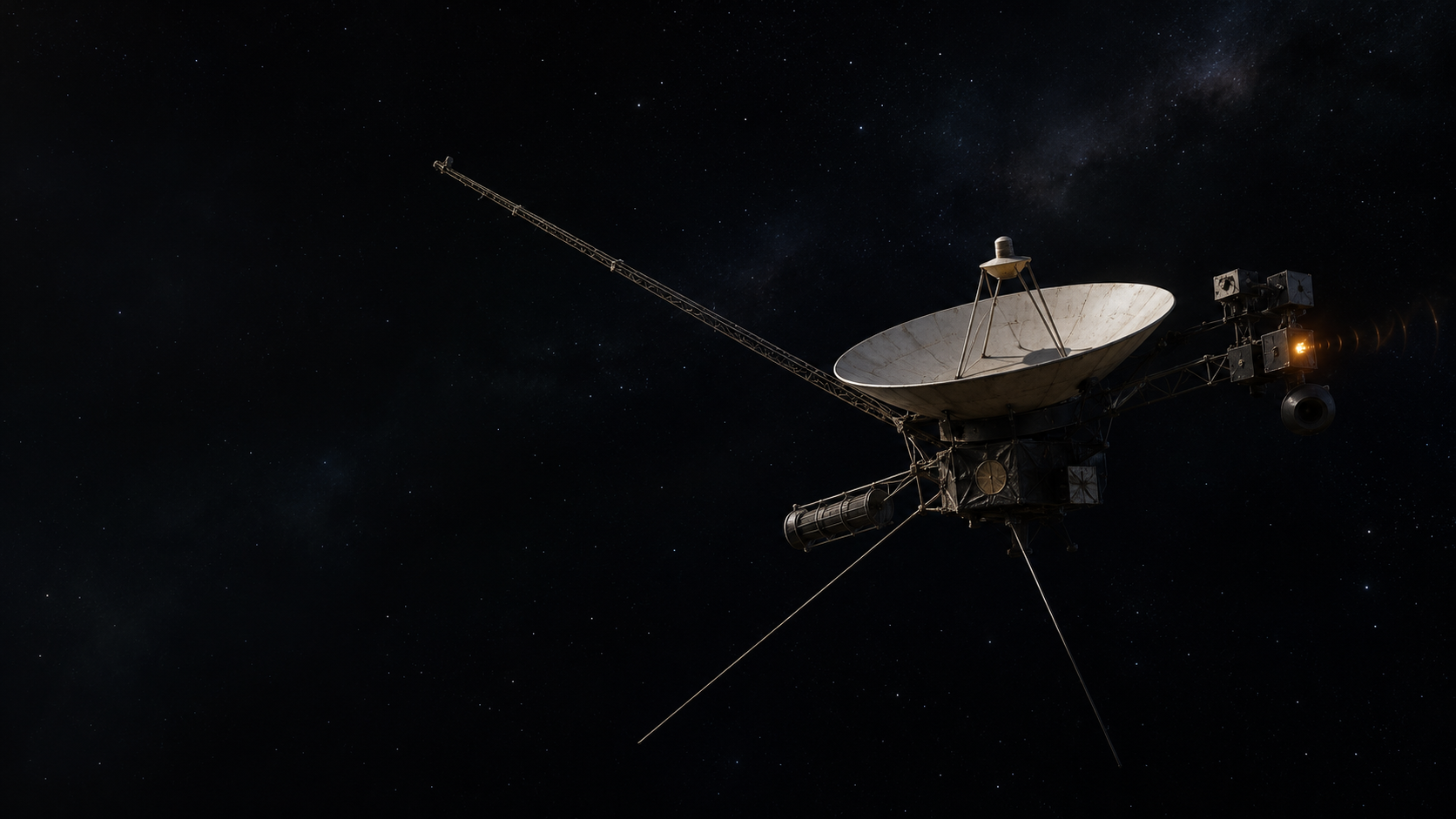
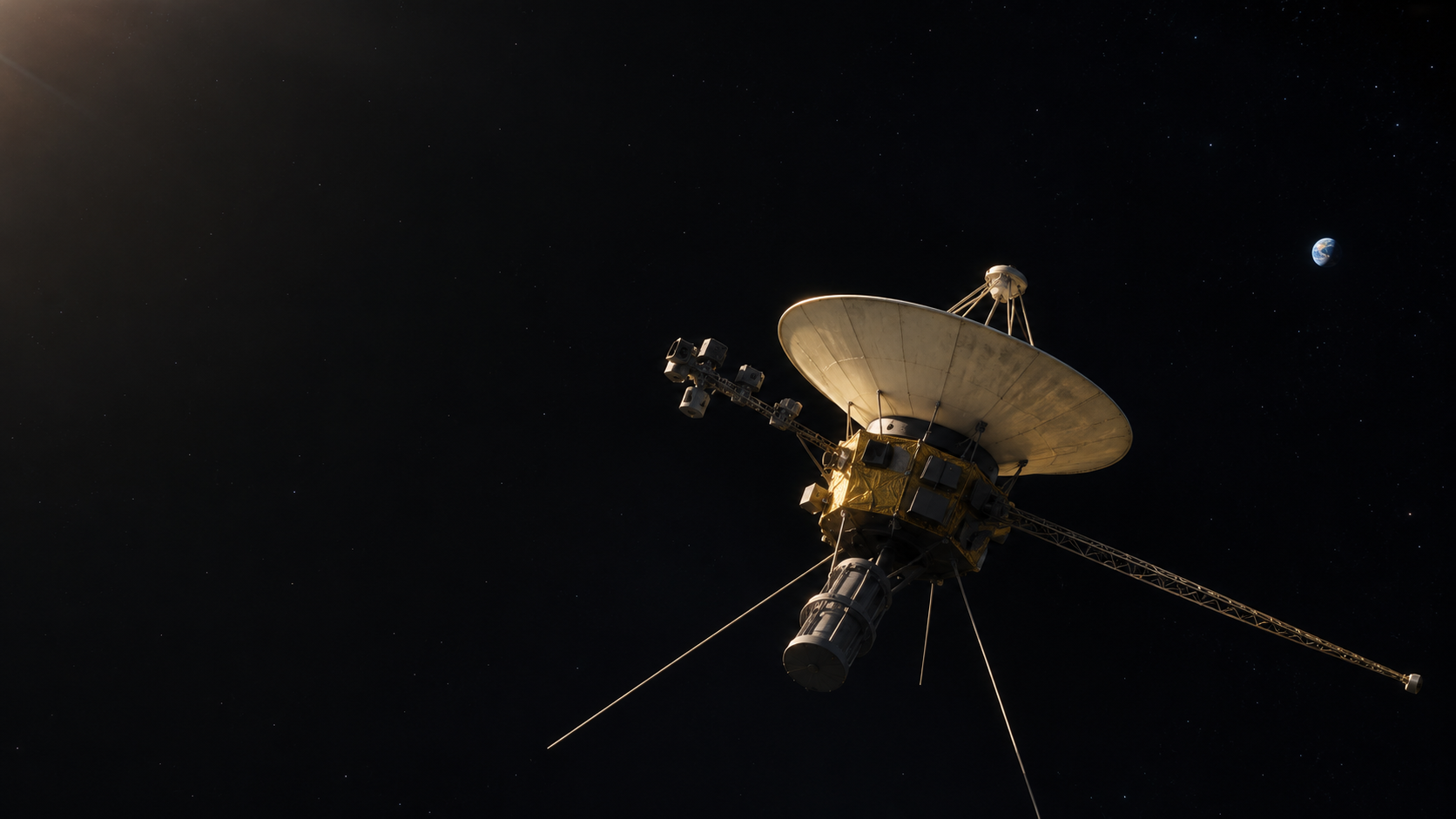
Voyager 1, the most distant human-made spacecraft, has reportedly stopped transmitting usable scientific data as it approaches—or may have reached—the distance of one light-day from Earth. The reports describe a data or communications problem, not necessarily a complete loss of contact. Source 1
What Happened to Voyager 1?
Reports characterize the incident as a new glitch affecting scientific data transmission. Scientific data includes measurements of particles, magnetic fields, plasma waves, and cosmic rays. It differs from engineering telemetry, which reports spacecraft temperature, power, computer status, and other system conditions.
A loss of science data does not automatically mean that Voyager 1 has stopped communicating. The spacecraft may still transmit engineering information, send a carrier signal, or receive commands. NASA engineers are assessing the fault and developing a possible recovery plan. Source 7
Possible causes include aging electronics, memory corruption, software faults, declining electrical power, instrument failure, or a problem in the communications path. No specific component should be treated as confirmed unless NASA identifies it in an official update. Source 3
What Is One Light-Day?
A light-day is the distance light travels in 24 hours: approximately 25.9 billion kilometers, or 16.1 billion miles. At that distance, a radio signal takes about one day to travel from Earth to Voyager 1. A command-and-response exchange takes roughly two days, excluding processing and analysis.
The milestone measures distance, not Voyager 1’s travel time at the speed of light. The spacecraft moves far more slowly than light, while radio signals travel at approximately light speed.
Reports differ on whether Voyager 1 was approaching or had crossed the one-light-day threshold. The discrepancy may reflect publication dates, rounding, changing distance, or different calculation methods. Source 9
Why Repair Is So Difficult
Voyager 1 launched in 1977 and uses computers, memory, software, and electronics designed for that era. NASA cannot physically replace its hardware. Engineers must identify the likely fault, model it on Earth, test commands against available documentation and hardware simulations, and transmit a carefully reviewed solution.
The spacecraft also relies on radioisotope thermoelectric generators. Their electrical output declines gradually as radioactive material decays. NASA has already reduced power consumption by turning off nonessential systems, adjusting heaters, and managing instruments carefully.
Communication is difficult for another reason: Voyager 1’s signal is extremely faint after traveling billions of kilometers. NASA depends on the Deep Space Network, whose antennas must account for spacecraft orientation, background noise, Earth’s rotation, and station availability.
Voyager 1 in Interstellar Space
NASA records that Voyager 1 crossed the heliopause in 2012. The heliopause marks the outer boundary of the heliosphere, the bubble created by the solar wind and the Sun’s magnetic influence. Crossing it placed Voyager 1 in interstellar space, although it has not necessarily left the solar system under definitions based on the Sun’s gravitational reach. NASA
Voyager 1’s instruments have measured plasma waves, magnetic fields, charged particles, cosmic rays, and conditions near and beyond the heliopause. These observations provide unique information about the interaction between the solar wind and interstellar plasma.
Losing scientific data therefore matters even if engineering telemetry continues. Engineering information can indicate whether the spacecraft remains powered, oriented, and responsive, but science data reveals the environment Voyager 1 is encountering. A partial recovery could restore some instruments or data channels, depending on the failed subsystem.
A Mission That Changed Space Exploration
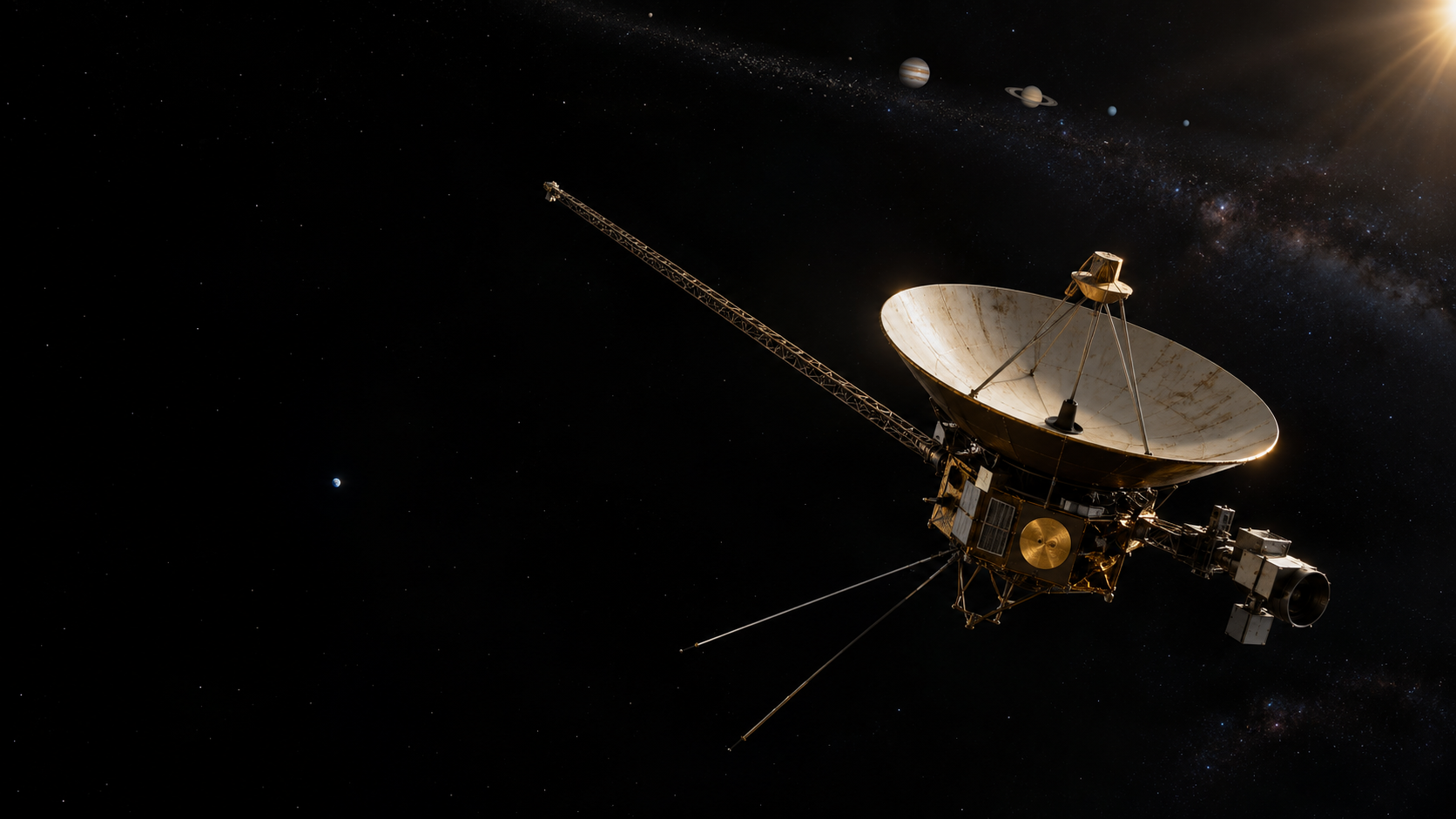
Voyager 1 made historic observations of Jupiter and Saturn and passed close to Saturn’s moon Titan. Its planetary encounters revealed active atmospheres, complex rings, and previously unknown details about the outer solar system.
The spacecraft later became the most distant human-made object and evolved from a planetary mission into an interstellar science mission. It also captured the famous “Pale Blue Dot” image in 1990, showing Earth as a tiny point in the darkness of space.
What NASA Could Do Next
NASA’s recovery process is likely to follow these steps:
- Analyze available telemetry and communication signals.
- Identify the most likely malfunctioning subsystem.
- Test commands, software changes, and alternate data paths on Earth.
- Transmit a carefully reviewed command.
- Wait for Voyager 1’s delayed response.
- Determine whether scientific data has returned.
A workaround could redirect data through another memory location, software route, computer function, or communications configuration. However, any command could affect systems that still operate, so NASA must balance recovery efforts against the risk to basic spacecraft health.
Conclusion
Voyager 1’s reported loss of scientific data near the one-light-day milestone reflects the combined effects of age, distance, declining power, and fragile communications. It does not automatically prove that the spacecraft has stopped operating altogether.
NASA’s engineers must diagnose the fault remotely, develop commands for limited 1970s-era computers, protect dwindling power reserves, and wait days for results. The outcome could range from restored science transmission to partial operation or engineering-only communications.
Whatever happens next, Voyager 1 has already transformed planetary science, expanded humanity’s reach into interstellar space, and demonstrated both the resilience of long-duration spacecraft and the limits imposed by deep space.
Frequently Asked Questions
Is Voyager 1 still communicating with Earth?
Reports describe a loss of scientific data or a related communications problem, not necessarily a complete loss of contact. The latest NASA update should be treated as the authoritative status.
How far is one light-day?
One light-day is approximately 25.9 billion kilometers, or 16.1 billion miles. A radio signal takes about one day to travel that distance one way.
Why did Voyager 1 stop sending scientific data?
The reported cause has not been confirmed. Possible explanations include aging electronics, memory corruption, software faults, declining power, instrument failure, and communications-system problems.
Can NASA repair Voyager 1?
NASA cannot physically repair the spacecraft. Engineers can transmit commands, modify operating instructions, redirect data paths, and activate available backup procedures.
When did Voyager 1 launch?
Voyager 1 launched in 1977. Its operation decades later greatly exceeds the expected duration of its original planetary mission.
Has Voyager 1 left the solar system?
Voyager 1 crossed the heliopause and entered interstellar space in 2012. However, leaving the heliosphere is not the same as traveling beyond the Sun’s entire gravitational domain.
Related Articles
-
 Beaver Supermoon: Meaning, Viewing, and Photography Guide
-
 Scientists Send a Message Through a Brick Wall Using Gravity
-
 NASA IBEX Reveals a Shifting Heliotail
-
 Spacecraft Reaches Mercury After Eight-Year Journey
-
 Earth’s Core May Preserve a 4.5-Billion-Year-Old Secret
-
 Webb Finds Possible Stellar Layer Mixing Before Cas A
-
 How to See November’s Beaver Moon Supermoon
-
 Voyager 1 Faces New Data Glitch in Historic Mission
-
 BepiColombo Mercury Arrival Clouded by Thruster Glitch
-
 Nature vs. Nurture: How Much Do Genes Matter?
-
 Voyager 1 Reaches a Reported One Light-Day From Earth
-
 17 Best Voyager 1 Photos and Why They Matter
-
 How the Brain Represents Meaning Across Languages
-
 Renewed Rifting Detected Beneath Southern Africa
-
 Stonehenge’s Altar Stone Came From Scotland, Not Wales
-
 Earth’s New Mini-Moon 2026 QQ8: How Long Will It Stay?